Transforming RGN from spreadsheets to a self-serve portal
I led the end-to-end design of a self-serve portal for campaign management, reporting, and validation.
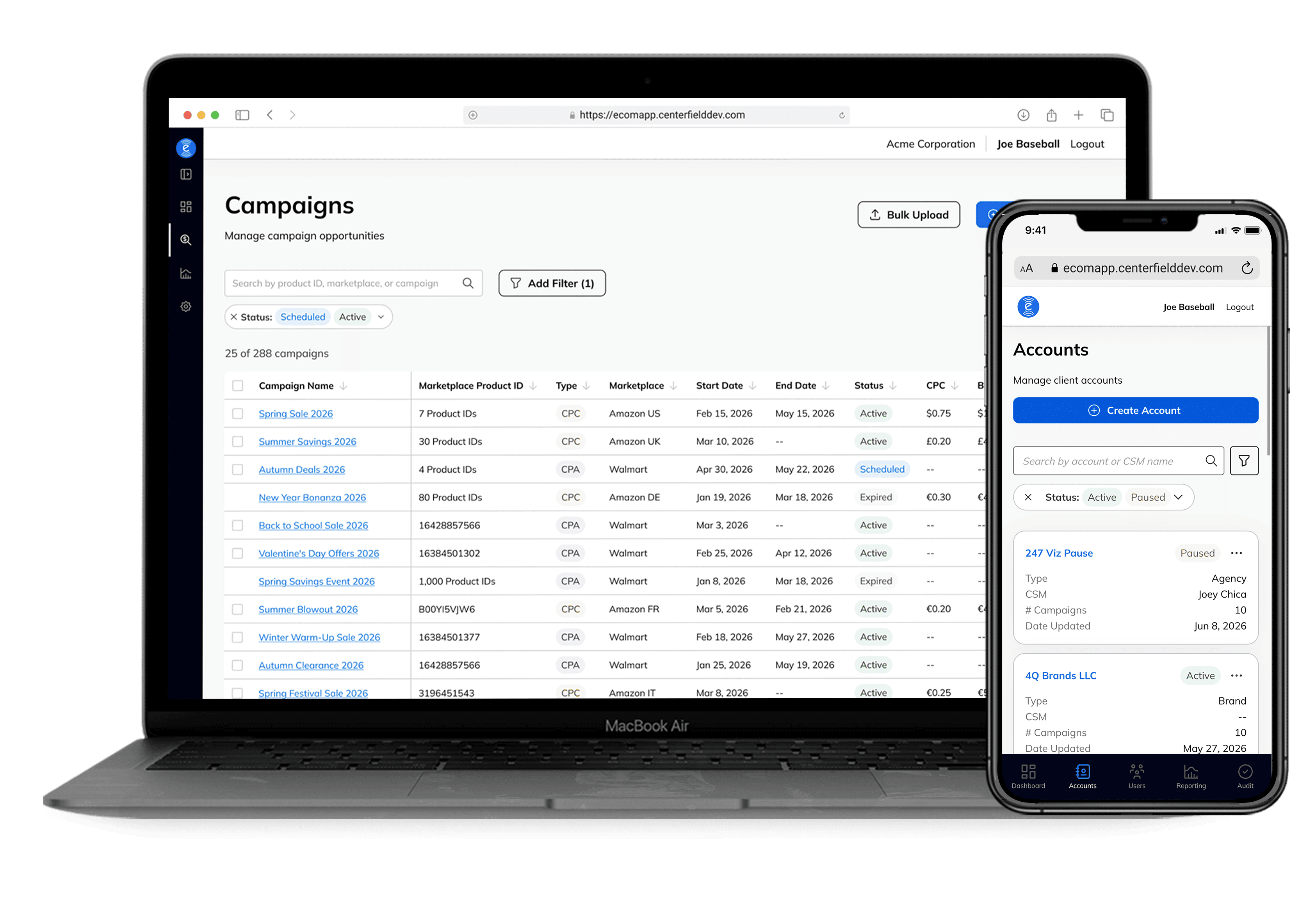
overview
Centerfield's Retail Growth Network (RGN) helps brands and aggregators manage product campaigns that drive traffic through sites and social media to marketplaces like Amazon and Walmart, earning commission or CPC revenue. However, the program ran entirely on spreadsheets, costing real revenue as the business scaled. I led the design of a self-serve client portal that replaced this manual process, built alongside engineering and product under a compressed 90-day timeline.
35%
1,000+
Campaign Capacity
$9.2M
project timeline
Mar - May 2026 · 90 days
my role
Product Designer
team
Product, Engineering, QA, Product Leadership)
my design skills in focus
Complex Product Systems
Cross-Functional Collaboration
Designing With AI

the problem
One wrong date input, in a slow manual process, cost a client 90% of their invoice

Every campaign update, upload, and reporting request depended on someone manually editing a PPL spreadsheet. With no built-in validation, one incorrect promotion end date reduced a client’s monthly invoice from $10,000 to $1,000. As RGN grew toward hundreds of client accounts and a $9.2M revenue base, both problems became a scaling bottleneck.
the solution
Building a faster, self-serve system that catches errors before they reach an invoice
The portal brings campaign uploads, edits, and reporting into one self-serve system. Built-in validation and automated business rules catch errors before campaigns go live, reducing manual work and revenue risk.
Self-Service
Clients can manage campaign uploads, edits, and reporting directly.
Built-In Safeguards
Validation and audit history catch errors and make changes traceable.
Built to Scale
Support a $9.2M revenue goal across hundreds of accounts and thousands of campaigns.
the context
How does RGN work and who uses it?
Brands and aggregators upload campaigns into RGN; Centerfield's marketing channels (social, product reviews) drive traffic to those promotions on marketplaces like Amazon and Walmart; sales and commission data flow back into reporting.
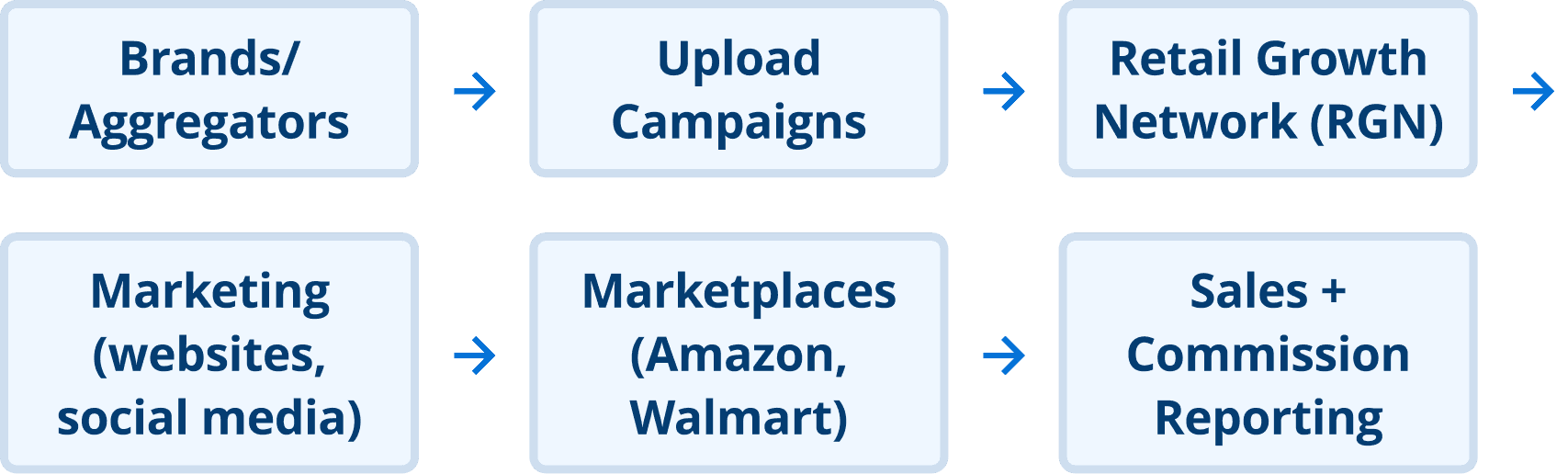
The new portal holds six different role types
Each client organization is represented by an account, with individual users receiving permissions based on their role. The portal supports three internal and three external roles, ranging from platform-wide management to view-only access.
the scope
Everything we built in 90 days
This project covered the core client campaign workflows and the internal tools needed to manage accounts, permissions, validation, and change history.
In Scope
Campaign management and reporting
Accounts, roles, validation, and audit trail
Multi-marketplace support
Out of Scope
Data warehouse (exists in BigQuery)
Internal reporting (exists in Looker Studio)
Invoicing and billing

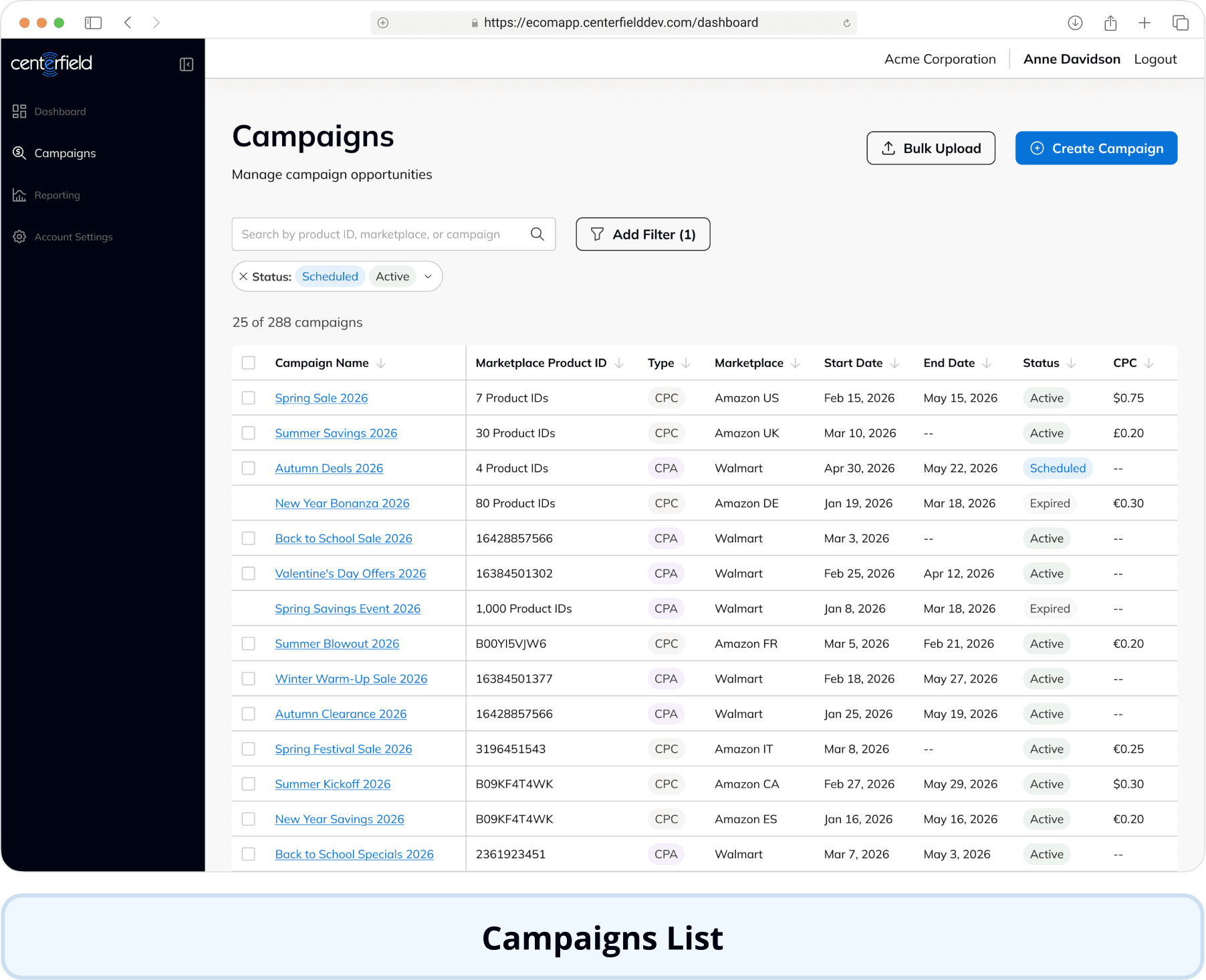
Client-facing design overview




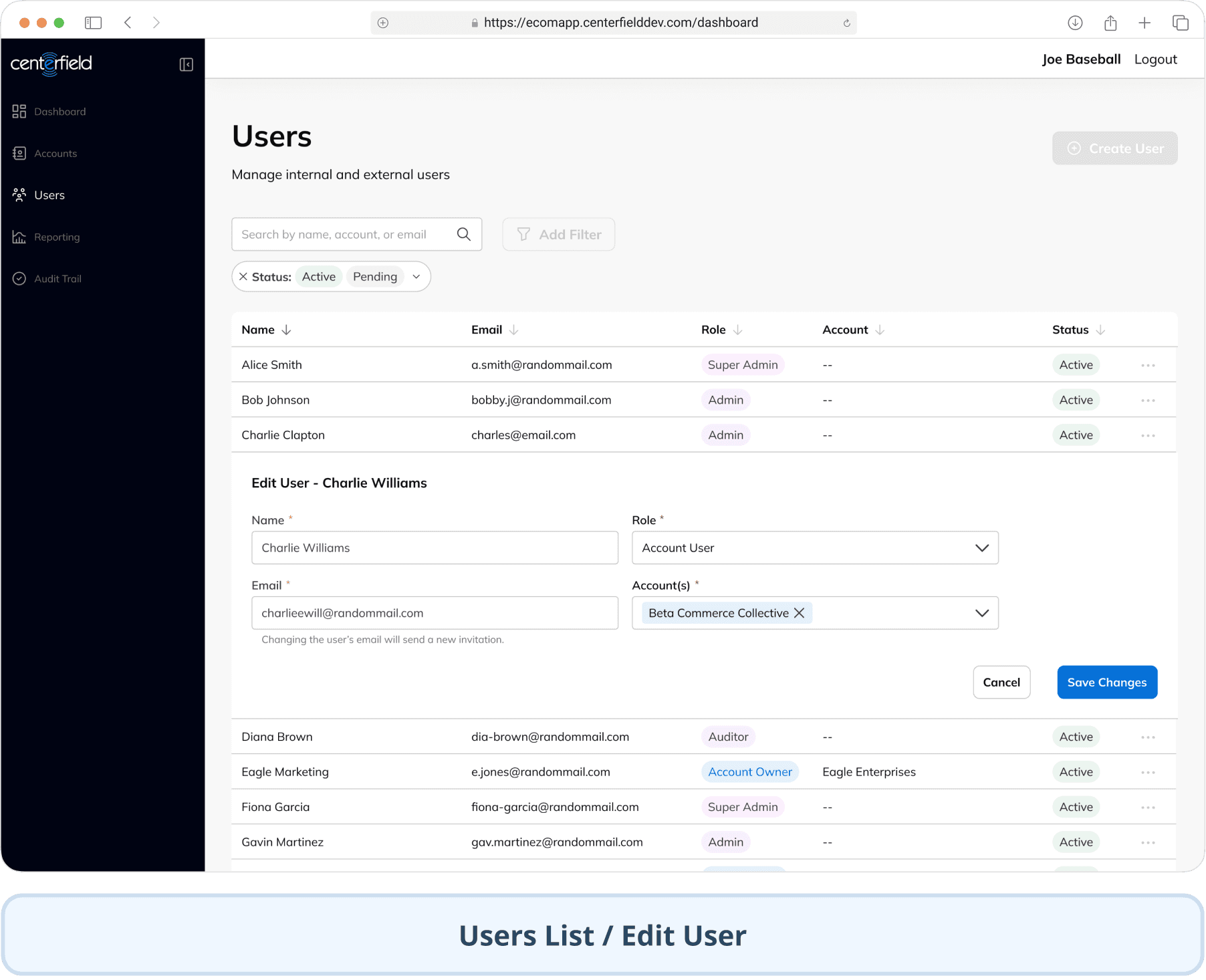
Internal-facing design overview




ai in design
Finding the right role for AI in my process
A workflow that got 35% faster in one week


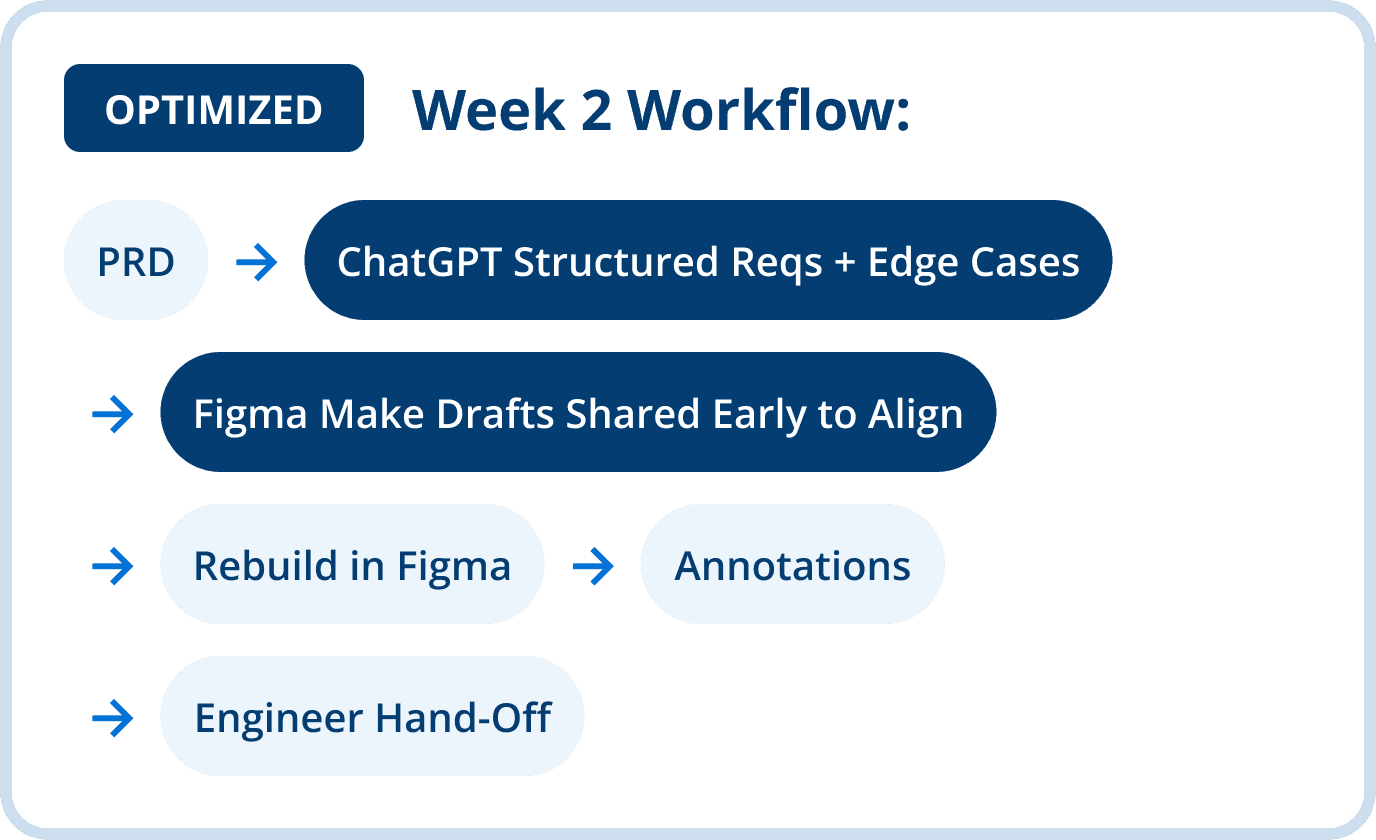

In the first week, I used ChatGPT to structure requirements and Figma Make to generate early concepts. However, edge cases surfaced after I’d rebuilt polished designs in Figma, which created extra rework.
By the second week, I moved edge-case discussions earlier and shared generated prototypes with product and engineering before refining them. This reduced my design workflow time by 35% while giving the team earlier opportunities to shape the solution.
Aligning my designs with how engineering built using AI
I adapted my handoff to support the way Thomas (front-end engineer) was building with Claude Code. Through our weekly syncs, I learned that detailed annotations clarifying behavior, interaction states, and open questions were more valuable for implementation than designing every scenario frame by frame in Figma.

Yuko (Myself)
Designer

Thomas
Front-End Engineer
Structured Figma files for Claude Code
→ Detailed dev annotations for Claude to read and implement.

Ideating solutions with the team in real time
AI came into play during team meetings as well. When product and I had different ideas about an approval-status pattern, it was difficult to discuss without visualizing. I generated a few options in Claude during the discussion, which made the trade-offs obvious in a way describing them out loud hadn't. This helped us align in one meeting instead of continuing the discussion asynchronously.


I additionally built a design system auditing tool
I also built a separate AI-powered design-system audit tool (Audit Lab) to check the RGN designs for issues with tokens, layers, accessibility, and copy. I later expanded it into a reusable internal tool that reduced a full design audit by 97%, from approximately 230 minutes to 5 minutes. I have since expanded it with the design team and presented it company-wide here.

the designs
Evolving the designs to changing requirements
We began with a high-level PRD from Neal (product director) with technical and UX details expected to follow. However, under the 90-day timeline, it became our working source of truth before some important gaps had been resolved. I continued moving the designs forward, keeping in mind we may need to revisit design decisions as requirements continued to evolve.
Adapting RGN’s campaign workflow to support CPC
RGN originally supported only CPA campaigns, where brands paid a commission for each sale. When Amazon stopped supporting CPA attribution during the build, we needed to add CPC campaigns without making existing workflows more complicated.
Shifting the focus from products to campaigns
A CPA promotion was tied to one product ID, so the original campaign list was organized around products. A CPC campaign could contain thousands of product IDs, making that structure difficult to scan. I shifted the hierarchy to campaign name and moved product-level detail into the Campaign Details page.

Keeping bulk editing simple across campaign types
Before CPC, bulk editing was straightforward because every campaign shared the same fields. Supporting two campaign types introduced different rules: CPC campaigns had budget and cost-per-click fields, while CPA campaigns had a commission rate. Rather than disabling rows or blocking mixed selections, I kept every campaign selectable. The fields available in the edit drawer changed based on the selection, allowing users to complete a valid bulk edit without starting over.


When promotions overlap, do we “block” or “chop”?
Without manual review, RGN needed one rule for overlapping campaigns. Neal, Aliya, and I mapped scenarios across manual creation, CSV uploads, sidebar edits, and API calls, then compared blocking the new campaign with “chopping” the existing evergreen campaign when the new one began.


Neal, Aliya, and I held a dedicated working session to map scenarios across manual creation, CSV uploads, sidebar edits, and API calls, then agreed on how each should behave.
Our potential approaches were:
Block (A): Reject overlapping promotions entirely.
Chop (B): Automatically end the existing promotion when the new one starts (with warning).
Yuko (Myself)
Designer

Aliya
Product Manager

Neal
Product Director
Working session to map scenarios
→ We chose “chop”. New campaign means evergreen campaign would auto-end. Clients can manually re-add after.

We chose “chop”. When a new promotion starts, it automatically ends the existing evergreen promotion. Blocking overlaps was simpler to build, but it treated legitimate changes—like adjusting promotion dates—as errors. We also considered automatically resuming the evergreen promotion afterward, but deferred it because of backend complexity. Clients could still re-add it manually, as they did before. Chop gave us one consistent rule across every entry method.
cross-functional collaboration
Turning different perspectives into shared decisions
We had two weeks—and two different ideas for the design system
At the start of the two-week sprint, Thomas and I preferred different design system foundations. I wanted to use the existing Mantine-based Platform design system, which was already used across the company’s in-house products. Thomas preferred ShadCN and Tailwind for development flexibility and AI-assisted code generation.
I met with Thomas and the Platform engineers to confirm that Mantine could work alongside Tailwind. Thomas and I then, used a working session to build a sample page with the existing system and tested how its components translated through Claude Code. The session confirmed that Mantine could work with Tailwind and provide the flexibility engineering needed. That meant we could build on the existing Platform design system and avoid creating an entirely new system.
Yuko (Myself)
Designer
Thomas
Front-End Engineer
ShadCN or Mantine for design system?
→ Testing confirmed Mantine could support the portal, so we used the existing system instead of building a new one.

Rethinking how restricted actions appear
Some roles had different permissions to edit or archive people from the Users list, so those actions needed a consistent UI treatment. I initially proposed disabled buttons, but Aliya pointed out that disabled controls imply users may eventually be able to enable them—which wasn’t possible here. After reviewing button best practices together, we moved the actions into an ellipsis menu instead.
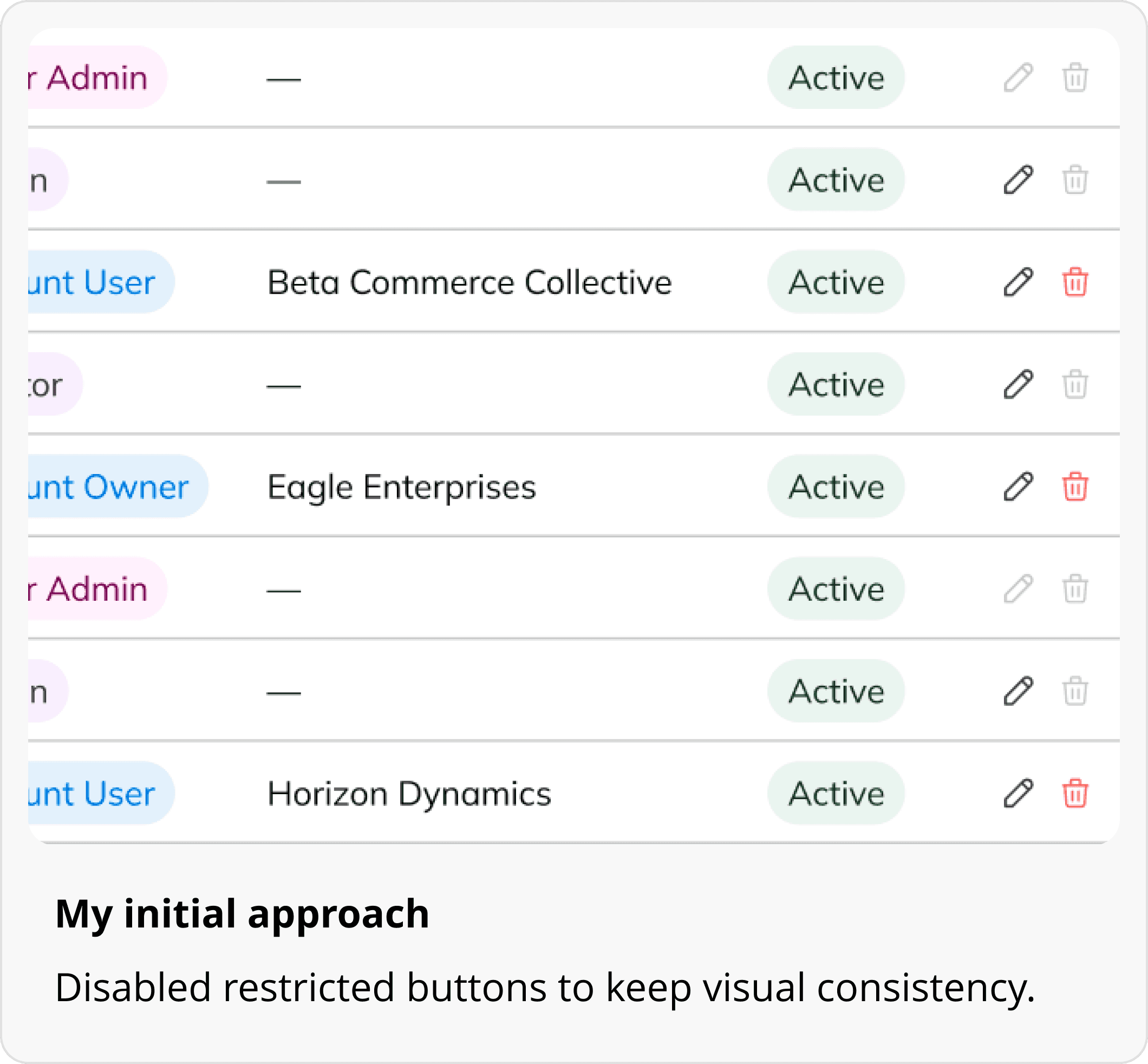

Yuko (Myself)
Designer
Aliya
Product Manager
Show or hide action buttons across different permission levels?
→ I came up with an alternate compromise by replacing disabled buttons with an ellipsis menu.

feedback & revisions
The portal was well received, and feedback helped us refine it
RGN is now fully rolled out and is fully in use. However, Phase 2 was deprioritized and I was not able to conduct the broader usability study with internal and external users that I had originally planned.
I still ran a final design walkthrough with stakeholders and internal users and recently held a follow-up session with two CSM internal users based on their experience with the live portal. I brought their feedback to Aliya, and we worked together to prioritize changes. Aliya has also continued sharing feedback from day-to-day use, which I have used to refine the designs.
We are so glad to be done with the PPL spreadsheets and this product is a great, great improvement.
This looks amazing. I'm excited for clients to start using it and it's such a big help than all of the sheets we were using before.

Carrie G.
CSM Director
Real requests reshaped the Performance Report
As internal users began working in the portal, the original reporting page no longer matched everything they needed. Their requests led me to add the following features:
1
Google Sheets export link
2
Currency controls
3
Campaign and product-level report views


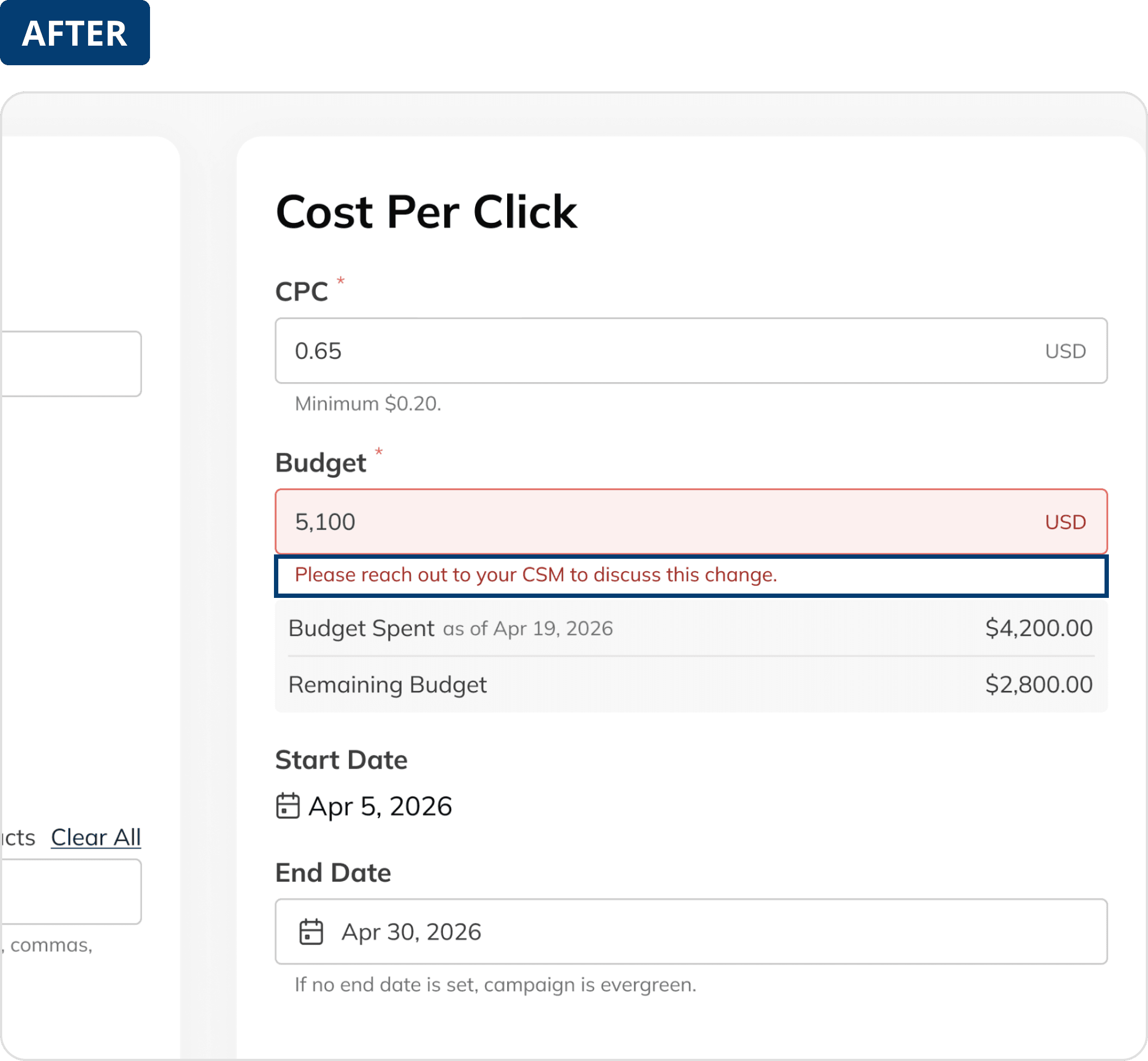
When the 25% limit started to sound like a suggestion
The campaign edit form originally stated that clients could not reduce a budget by more than 25% at once. Stakeholders pointed out that showing the limit could encourage clients to reduce it by the full amount, even though significant changes were intended to involve their CSM. I removed the percentage from the helper text while keeping the rule as system validation. The marketplace minimum remained visible, but exceeding the 25% threshold prompted the client to contact their CSM.

results
From spreadsheets to a portal supporting a $9.2M revenue base
$9.2M Revenue
1,000+ Campaigns
~1/8 the Cost
Compared with earlier Salesforce and outsourcing estimates
~8× the Speed
The self-serve portal launched within the original 90-day timeline, despite a mid-build pivot that reshaped the campaign data model and a full redesign of how the system handles approval. It now supports RGN's existing $9.2M revenue base, replacing a manual spreadsheet process with one that validates and processes 1,000+ campaigns in a single bulk action. The clearest impact of the initial release is capacity: RGN can now support its existing business and growing campaign volume without being bottlenecked by manual PPL spreadsheets.
The AI-assisted approach also helped our team as a whole, deliver the portal at an estimated one-eighth of the cost and increased design and development time by roughly eight times. It reduced my design workflow time by 35%, which I covered in more detail under Designing With AI.
reflection
This project changed how I work
The biggest lessons came from how we worked through uncertainty while product, design, and engineering moved in parallel. Our retro helped clarify three practices I’d carry into the next project.
Working through ambiguity 🧠
The project moved quickly, with product, design, and engineering working in parallel while requirements continued to evolve. I prioritized high-impact decisions, stayed closely aligned with my PM, engineer, and QA, and marked unresolved details as TBD rather than treating assumptions as final.
Protecting time for requirements upfront 🕰️
Starting before the PRD was finalized maintained momentum, but led to repeated rework as business rules and edge cases became clearer. In our full-team retro, we agreed that next time, we would allocate more time for product to fully define the requirements—even under a tight deadline—before moving forward.
Making AI-generated changes easier to track 🔎
As engineering used Claude to build the portal, it sometimes added elements beyond the designs I had handed off. This made changes difficult to identify. Next time, engineering and I will have a shared process to review and document AI-generated changes.
